What the Bernischer Forstverein Discovered Through WaldWege
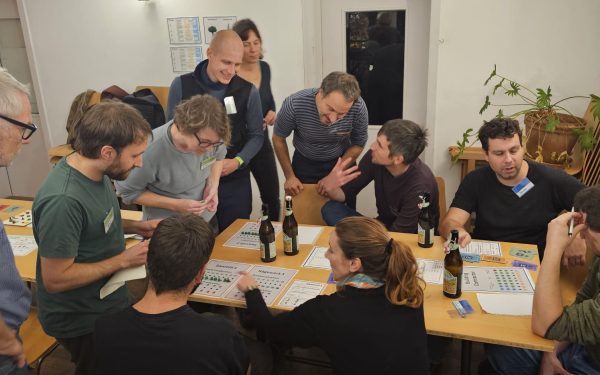
In October 2025, members of the Bernischer Forstverein came together to play a game. And within minutes, it became clear that WaldWege (Forest Paths), our forest and wood supply chain strategy game, reveals more about real forest systems than many conventional workshops ever do.
Developed by LEAF Inspiring Change together with FSC Switzerland and supported by the Bern University of Applied Sciences and the Pädagogische Hochschule Zürich, the game places players in charge of foresters, sawmills, and construction companies over 150 simulated years. The rules are simple. The outcomes shaped by the decisions, assumptions, negotiations, and trade-offs made by the people in the room.
What the Session revealed
The experience made several dynamics visible that are highly relevant for forestry practitioners and sector organisations:
Communication under pressure: Time constraints affected coordination, and full transparency sometimes weakened negotiating positions.
Incentive structures: Economic incentives often overrode intended sustainability goals, even among experienced professionals.
Misaligned feedback loops: In one scenario, increased hardwood management improved forest conditions and reduced pest risk, but this positive effect never reached the building industry, because the material was used as energy by sawmills rather than as construction wood.
Certification dynamics: Certification initially facilitated cooperation, but trust eroded rapidly once a few actors used it opportunistically.
System shocks: Responses to shocks and delays create unequal outcomes, even with identical starting conditions.
Collaboration: Teams tended to perform more consistently than individuals working alone.
These observations are not abstract. They mirror the very real tensions forestry practitioners face every day.
Negotiations along the wood supply chain
WaldWege Game
A Tool for Practitioners navigating complex Forestry Realities
WaldWege was designed as a strategy game, but practitioners quickly recognise its practical relevance. The game allows professionals to experiment with decisions they normally need to get right the first time – harvesting strategies, long-term regeneration, dealing with disturbances, balancing biodiversity subsidies, or navigating market shifts. The game models forest dynamics, protection functions, certification pathways, climate impacts and wood supply chain interactions in realistic ways.
But more importantly, it creates a shared space where foresters, sawmills and construction actors can see how their respective decisions collide, reinforce, or undermine each other. Practitioners often tell us that playing the game gives them what daily work rarely offers: the full picture.
It makes visible that sustainable forestry is not just silviculture. It is long-time planning, negotiation, coordination, incentive design, risk management, market foresight, and system thinking. In WaldWege, this is compressed into just a few hours of intense, often emotional decision-making.
Strengthening shared understanding
Sessions like the one with the Bernischer Forstverein show how experiential formats can help forestry actors build a comprehensive picture of system behaviour and identify where coordination challenges originate. By working through realistic scenarios in a structured setting, participants gain insights that can inform strategic conversations, planning processes, and collaboration efforts across the forest–wood sector.